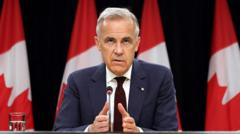
Canada just triggered the biggest military purchase in its history, and honestly, it is not just about defending the coastline. Prime Minister Mark Carney stood at Canadian Forces Base Halifax and announced that German manufacturer Thyssenkrupp Marine Systems (TKMS) is the preferred supplier to build up to 12 new stealth submarines.
For decades, Canada treated its military spending like an annoying chore. That era is officially dead.
The background matters here. Canada has been under relentless pressure from NATO and Washington to take national security seriously. For years, Ottawa lagged far behind the alliance's target of spending 2% of GDP on defence. But Carney’s government recently hit that 2% mark for the first time since the Berlin Wall crumbled. This mega-deal for the TKMS Type 212CD submarine fleet is the exclamation point on that shift.
If you are wondering why Canada is suddenly spending tens of billions on underwater warfare, the answer lies in the Arctic. Melting ice is opening up northern shipping lanes. Russian and Chinese vessels are sniffing around Canadian waters with increasing frequency. Canada’s current four Victoria-class submarines are ancient, notoriously unreliable, and completely unsuited for under-ice operations.
The Canadian Patrol Submarine Project aims to change that by introducing ultra-low acoustic and magnetic signatures to the Royal Canadian Navy. These German-designed boats are among the quietest on earth. They give Ottawa the teeth to actually patrol its own freezing backyard.
What the mainstream media missed is the massive geopolitical pivot hiding in plain sight.
Historically, Canada buys roughly 70% to 75% of its military hardware from the United States. But there is no American option for this specific need. The US Navy only builds massive, nuclear-powered submarines. Canada needs smaller, highly advanced conventionally powered (diesel-electric) submarines that can sneak around under ice shelves.
By choosing Germany’s TKMS over South Korean competitor Hanwha Ocean, Canada did not just buy hardware—it bought a deep strategic alliance with Europe. Germany and Norway already share the 212CD platform. By joining this specific ecosystem, Canada aligns its naval operations directly with its northern European NATO allies.
It is part of a broader trend. Just recently, Montreal-based Marconi Technologies snagged Canada’s first contract under a new defence agreement with the European Union. Canada is diversifying its defense portfolio so it does not rely solely on the US industrial complex.
The timeline for this project is incredibly tight for military standards. The Canadian government wants contracts finalized by the end of 2027. If negotiations with TKMS hit a wall, the government explicitly noted that South Korea's Hanwha Ocean is waiting in the wings as the backup choice.
The first four submarines are scheduled for delivery by 2034. That sounds far away, but in the world of naval procurement, it is practically tomorrow. The old Victoria-class fleet will be stretched to its absolute limits to stay operational into the mid-to-late 2030s while the transition happens.
Carney is selling this to voters as an economic engine, not just a military line item. The deal falls under a strict "Build-Partner-Buy" framework. Under Canada's modernized Industrial and Technological Benefits Policy, foreign contractors must pour money back into the domestic supply chain.
The government recently launched the Defence Investment Agency to cut the bureaucratic red tape that usually kills these projects. If you run a Canadian manufacturing or tech firm, keep your eyes on the upcoming Defence Advisory Forum opening for applications. The government is actively looking for local suppliers to absorb a chunk of the $180 billion in procurement opportunities landing over the next decade. Track the procurement updates directly through the Defence Investment Agency portal to position your business for supply chain subcontracts.