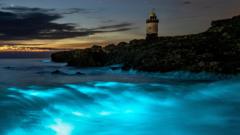
You don't need to fly to the Maldives or Puerto Rico to see the ocean turn a brilliant, electric blue. It's happening right now on British coastlines. Waves are crashing against the shore and leaving trails of neon light in their wake. Locals are calling it magical. Photographers are losing their minds.
This isn't a sci-fi movie. It's a natural phenomenon driven by billions of single-celled marine organisms called dinoflagellates, specifically a species known as Noctiluca scintillans. Most people call it sea sparkle. When these microscopic creatures get disturbed by moving water, they emit a sudden flash of bright blue light. The result is a surreal, glowing shoreline that transforms a routine late-night beach walk into something unforgettable.
If you want to catch this neon spectacle yourself, you need to understand exactly what triggers these blooms, where they show up, and how to track them down before they vanish.
The Weird Science of Living Light
The blinding blue light isn't a steady glow. It's a defense mechanism. Imagine being a microscopic plankton floating helplessly in a massive ocean. When a small fish or shrimp swims near you, intending to make you its dinner, you need a way to fight back.
Dinoflagellates use light as an alarm system. When they experience mechanical stress—like the physical churning of a breaking wave, a boat hull passing by, or a predator's jaw snapping shut—they trigger a rapid chemical reaction inside their bodies. This reaction involves two main components: a light-emitting molecule called luciferin and an enzyme called luciferase.
When oxygen reacts with luciferin under the guidance of luciferase, it releases energy. That energy takes the form of visible blue light. It's a type of cold light. This means nearly 100% of the energy is converted into light rather than heat. If the reaction generated heat, the tiny plankton would cook themselves from the inside out.
The biological goal of this flashing light is brilliant. It startles the predator, giving the plankton a split second to escape. Even better, it acts as a literal burglar alarm. By illuminating the predator, the plankton reveals the hunter's location to even larger predators nearby. The enemy of my enemy is my friend.
The human experience of this defense mechanism is purely accidental. The plankton can't tell the difference between a hungry shrimp and a breaking wave. They can't tell the difference between a fish and your foot wading through the shallows. Any agitation triggers the flash. When billions of them react at once in the surf, the entire wave appears to burst into an electric blue flame.
Where and When to Find Sea Sparkle
Catching a bioluminescent bloom requires the right combination of weather, timing, and patience. These organisms aren't permanent residents of the shoreline. They drift with the currents and multiply rapidly when conditions line up perfectly.
Historically, people associated these displays with tropical waters. But the UK coast has seen a dramatic increase in sightings over recent years. Hotspots frequently pop up around Wales, Cornwall, Dorset, and even parts of northern England and Scotland. Beaches like Penmon Point on Anglesey, Caswell Bay in Gower, and Aberavon Beach in Port Talbot have become famous for their summer displays.
You need to look for specific environmental cues. The plankton thrive in warm, calm weather. When the sun beats down on the ocean for several days straight during the late spring and summer months, the water temperature rises. This warmth, combined with calm seas that keep the organisms from being dispersed too widely, creates the perfect environment for a population explosion.
During the day, a massive concentration of these organisms looks entirely different. It doesn't glow. Instead, it forms a rusty brown or pinkish-red scum on the surface of the water. This is commonly known as a red tide. If you're walking along a beach in the afternoon and notice thick patches of discolored, reddish water near the shore, note the location. You want to return to that exact spot after dark.
Timing the night visit matters immensely. You need absolute darkness.
A bright, full moon can easily wash out the delicate blue light of the plankton. Check the moon phases and aim for nights with a new moon or times when the moon has already set. Turn off your phone flashlight. Let your eyes adjust to the pitch black for at least fifteen minutes. Even a small amount of artificial light pollution from a nearby promenade or a headlamp can ruin the visibility of the glow.
How to Interact with the Glowing Waves
Seeing the glow from a distance is great, but interacting with it directly is completely different. Because the light requires movement to trigger, a completely flat, calm sea might hide a massive population of plankton. If the water isn't moving, they won't light up.
If you find yourself on a quiet beach and suspect the plankton are present, try agitating the water yourself. Toss a stone into the sea. If the organisms are there, you'll see a bright blue splash where the stone hits the surface. Step into the shallow surf. Every footstep will leave a glowing footprint that lingers for a second before fading back into the dark.
You can scoop up a handful of the water. The plankton will wash over your skin, making your fingers look like they're covered in glowing, liquid stars. Swimmers who venture into bioluminescent waters describe it as moving through a galaxy. Every stroke of your arms creates a trailing vortex of neon light.
If you're a photographer trying to capture this phenomenon, leave your phone's automatic settings behind. Smartphone cameras struggle heavily in low-light environments without a flash, and using a flash will completely erase the bioluminescence.
You need a camera that allows for manual control over the settings. Use a sturdy tripod to prevent any camera shake. Set your lens to its widest aperture, such as f/1.4, f/1.8, or f/2.8, to let in as much ambient light as possible. Push your ISO up to 1600 or 3200, and use a long exposure time between 5 and 15 seconds. This long exposure allows the camera to collect the faint flashes of light over time, resulting in those striking images where the entire wave looks like a solid sheet of neon blue.
The Hidden Costs of Environmental Blooms
While these glowing seas are undeniably beautiful, they carry a hidden environmental warning. A massive bloom of Noctiluca scintillans isn't always a sign of a healthy marine ecosystem. Sometimes, it indicates the exact opposite.
Plankton populations explode when they have an abundance of nutrients to feed on. Warm weather helps, but agricultural runoff makes it much worse. When heavy rain washes fertilizers, pesticides, and animal waste from nearby farmlands into rivers and out into the ocean, it introduces massive amounts of nitrogen and phosphorus into the coastal waters.
This sudden influx of artificial nutrients acts like plant food for the micro-algae. They consume it and reproduce at an exponential rate, creating the massive blooms we see from the shore.
The problem arises when the bloom begins to die off. As billions of these tiny organisms reach the end of their lifespans, they sink to the bottom of the water column and begin to decay. Microscopic bacteria break down the dead plankton, a process that consumes vast amounts of dissolved oxygen from the surrounding water. If the bloom is large enough, it can deplete the oxygen levels so severely that fish, crabs, and other marine life literally suffocate, creating localized dead zones.
Noctiluca scintillans itself poses another direct threat to marine life. While it doesn't produce the dangerous neurotoxins found in some other red tide organisms, it accumulates massive amounts of ammonia within its cellular structure. As the plankton multiply and concentrate in shallow bays, they excrete this ammonia directly into the water. High concentrations of ammonia are highly toxic to fish and can irritate the gills of larger marine animals, driving them away from their traditional feeding grounds.
What looks like a magical, alien paradise on the surface can sometimes be an ecological distress signal underneath. It's a reminder of how deeply human activity on land impacts the delicate balance of the ocean.
Track Your Next Adventure
If you're ready to hunt down this neon display, don't just head out blindly to the nearest beach. Use the collective knowledge of communities who track these blooms in real-time.
- Join local spotting groups: Search for regional bioluminescent plankton groups on platforms like Facebook. Groups dedicated to the Welsh coast or Cornish beaches have thousands of active members who post live updates, exact coordinates, and real-time photos when a bloom is active.
- Watch the daytime weather: Keep a close eye on the local forecast. Look for sequences of three or more consecutive days of unusually warm, sunny weather with minimal wind.
- Inspect the shoreline by day: Take a walk along your chosen beach during the late afternoon. Look for patches of rusty, discolored red or pink water near the shoreline. If you find them, mark the spot and prepare to return after midnight.
- Pack for the dark: Bring a sturdy tripod, a manual camera, and warm layers. Standing on a dark beach at 2:00 AM gets cold quickly, even in the middle of summer. Leave the flashlights and headlamps in your bag to protect your night vision.
Get out to the coast during the next warm spell, turn off your phone, and watch the surf closely. You might just catch nature's most spectacular light show right on your doorstep.