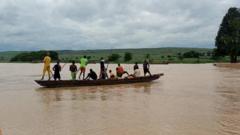
Every time a boat capsizes on a Nigerian river, the headlines follow a predictable, tragic pattern. We see the numbers of the dead, the images of grieving families, and vague promises from officials to "investigate" or "tighten regulations." Then, the news cycle moves on. Weeks later, another wooden vessel splits in two or flips in a storm, and the cycle repeats.
If you are looking for a simple answer as to why this keeps happening, there isn't one. It’s a messy blend of systemic neglect, economic desperation, and a total failure of basic safety culture. When you’ve spent any time observing the transport sector in Nigeria, you quickly realize that the issue isn’t a lack of rules—it’s a total absence of accountability.
The Reality Behind the Tragedy
When a boat sinks in Kebbi or Niger State, the immediate cause is often cited as a "collision with an object" or "turbulent weather." That’s the surface-level truth. It’s the "what," not the "why."
Most of these vessels are local, wooden boats that were never designed for the volume of passengers they carry. They aren’t just overloaded; they are essentially floating death traps. Operators frequently avoid official jetties—where they might be subject to taxes or inspections—and instead pick up passengers at unregulated, hidden spots along the riverbank. By the time a boat reaches the middle of the Niger or Benue, it’s often carrying double or triple its intended capacity.
It’s easy to blame the boat captain. It’s harder to acknowledge that for many in these rural communities, this boat is the only connection to the market. They don’t have an alternative. When you’re living on the edge, safety feels like a luxury you can’t afford.
Why Current Safety Efforts Fall Short
The government often points to the distribution of life jackets as a "solution." Honestly, it’s a distraction. You can hand out ten thousand life jackets, but if the boat is structurally unsound or piloted by someone who can’t read the water, a vest won’t save you.
I’ve seen firsthand how these systems operate. Enforcement is often performative. You might see a crackdown after a massive disaster, but it rarely sticks. The regulatory agencies are chronically underfunded and understaffed. They lack the boats, the fuel, and the personnel to patrol thousands of kilometers of inland waterways.
Furthermore, there is a fundamental disconnect between the "Inland Waterways Transport Code" and the daily reality on the river. Rules that sound good in an office in Abuja—like mandatory passenger manifests or strict operating hours—are ignored in rural districts because the local economy depends on fluidity. If you stop every overloaded boat, you effectively stop the region's trade. That’s a hard pill for local administrators to swallow.
Moving Beyond Paper Policies
If we actually want to stop the loss of life, we have to stop treating this like a PR problem for the government. Here’s what would actually make a difference:
- Mandatory Vessel Certification: It isn't enough to just register a boat. We need periodic, non-negotiable inspections that actually look at the structural integrity of wooden hulls. If it’s rotten or improperly repaired, it doesn't leave the dock.
- Infrastructure at the Jetties: Instead of just putting marshals on the ground, build proper, regulated jetties that are the only legal places to load. Make it easy for operators to do the right thing and impossible for them to operate in the shadows.
- Training for Local Operators: Most captains learn by osmosis, not training. We need a massive, localized effort to teach basic navigation, emergency response, and weight distribution. If you don't know how to balance a load, you shouldn't be allowed to drive.
- Emergency Response Units: When an accident happens, minutes matter. Right now, rescue often depends on local fishermen who happen to be nearby. That’s not a system; that’s luck. We need rapid response boats stationed at high-risk points along major rivers, equipped with basic medical gear and rescue divers.
What You Should Know
Don't buy into the idea that these accidents are just "natural disasters" or "acts of God." They are preventable. Every time you see a headline about a boat capsizing, recognize that it is a failure of policy and infrastructure.
If you are traveling on these waters, you have to be your own safety advocate. If a boat looks overloaded, don't get on it. If life jackets aren't available or are in such poor condition that they wouldn't float, don't get on it. It’s an inconvenient choice, but in a system that won't prioritize your life, you have to do it yourself.
The cycle of tragedy won't break until the cost of being unsafe becomes higher than the cost of following the rules. Until then, these rivers will remain far more dangerous than they have any right to be.