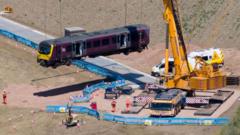
A high-speed rail line is a system built on overlapping safety blankets. When two trains end up on the exact same stretch of track, traveling in the same direction, it means multiple layers of safety failed at the exact same time. On June 19, 2026, those layers failed near Elstow, just south of Bedford.
An East Midlands Railway (EMR) Connect service from Corby slammed into the back of a stationary EMR Intercity Aurora train from Nottingham. The crash killed the driver of the rear train, injured over 100 passengers, and left eight people fighting for their lives in critical condition. If you found value in this article, you might want to read: this related article.
The media immediately jumped on the easiest narrative: a Signal Passed at Danger (SPAD), commonly known as running a red light. But pinning a major rail disaster entirely on a deceased driver ignores the fundamental reality of modern rail safety infrastructure. If a driver misses a signal, the system is supposed to step in.
Here is what went wrong, what the initial headlines missed, and why the fallout will reshape British rail policy for years. For another angle on this development, check out the recent coverage from Associated Press.
The Collision Mechanics at Elstow
The 15:50 Nottingham to London St Pancras service, operated by a brand-new Class 810 Aurora unit, experienced an onboard technical fault and came to a stop on the "up fast" line. Minutes later, the 16:40 Corby to St Pancras service, a 20-year-old Class 360 Desiro unit, entered the same block of track.
At 17:12 BST, the older Class 360 train collided with the rear of the stationary Aurora unit.
The impact derailed a carriage on the front train and completely crushed the driving cab of the rear train, killing the driver instantly. The force of the deceleration tore through the passenger compartments, throwing commuters out of their seats and shattering interior fixtures.
Why the Safety Nets Didn't Work
Every major line in the UK uses an Automatic Train Protection system or an Automatic Warning System (AWS) to prevent exactly this scenario. If a train passes a yellow or red signal, a horn sounds in the cab. If the driver does not acknowledge it within seconds, the brakes apply automatically.
Investigators from the Rail Accident Investigation Branch (RAIB) are focusing heavily on why this intervention failed. Early reports suggest that particular stretch of track lacked the Train Protection and Warning System (TPWS) loops capable of forcing an automatic emergency stop if a red signal is blown at speed.
When safety systems rely on the driver to manually cancel a warning chime based on memory, human vulnerability enters the equation. If a driver misinterprets a signal sequence—assuming a line is clear because of a previous green light—the margin for error drops to zero.
The Furniture Problem and Passenger Injuries
The starkest discrepancy in the aftermath was the sheer volume of severe trauma cases despite the carriages remaining mostly upright and on the tracks. Out of 100 injuries, 11 were classified as "very serious" and 32 as serious.
The layout of modern commuter trains inadvertently increased the severity of these injuries. Passengers sitting at fixed tables or standing in the aisles were transformed into projectiles during the sudden stop. Necks snapped, ribs fractured against table edges, and luggage stored overhead broke loose.
While crumple zones in the carriage ends absorbed enough energy to prevent total structural collapse, the interior design failed to restrain the human cargo. The RAIB inquiry will undoubtedly scrutinize the crashworthiness of airline-style seating versus table layouts in high-density commuter trains.
Immediate Steps for the UK Rail Network
This disaster is Britain’s second fatal multi-train collision in less than two years, following a fatal crash in mid-Wales in late 2024. The era of flawless safety records on the UK network is facing structural strain.
If you manage logistics or travel frequently along the Midland Main Line, expect long-term changes to regional transport:
- Infrastructure Lockout: The section between Luton and Bedford is completely closed until at least June 28. Crews have to clear the wreckage, lay 600 meters of new track, and rebuild damaged trackside signaling equipment.
- Slower Line Speeds: Network Rail will likely implement temporary speed restrictions across similar legacy signaling blocks while the RAIB completes its interim investigation.
- Accelerated ETCS Rollout: Pressure will mount on the Department for Transport to speed up the installation of the European Train Control System (ETCS), which uses continuous digital cab signaling to override manual mistakes completely, removing the reliance on visual trackside signals.
The investigation continues, but blaming a single human variable will not fix the systemic gap that allowed two modern trains to share the same line at full speed.
For a visual breakdown of how rescue teams and investigators managed the wreckage in the hours following the collision, watch the Bedford train crash news package. This report shows the scale of the emergency response and highlights the specific field locations where local emergency services triage operations took place.