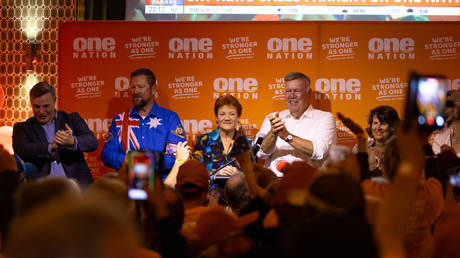
Australia used to pride itself on being an island of relative political sanity. While the US tore itself apart over MAGA culture wars and Europe watched right-wing populists storm parliament buildings, Canberra stayed mostly boring. Governments changed hands with polite handshakes. The political center always held.
Not anymore.
A quiet fury has been brewing under the surface of Australian society, and it just exploded into the open. Recent polling numbers dropped a bomb on the political establishment. Pauline Hanson’s One Nation party, long written off by elite commentators as a fringe group of outer-suburban contrarians, suddenly surged to lead or tie the primary vote in major surveys. We are talking about a party that usually scratches around for five or six percent of the vote suddenly hitting 30% to 31.5% in YouGov and Roy Morgan polls. It outpaced the ruling Labor party and left the traditional center-right Liberal-National Coalition bleeding out in the ditch.
If you want to understand why everyday Aussies are suddenly looking at radical political disruptors, you have to look past the lazy media headlines. This isn't a sudden outbreak of collective madness. It is a completely rational, predictable response from people who feel like their own government stopped caring about them years ago.
The Breaking Point of the Australian Dream
For decades, the unwritten contract of Australian life was simple. You work your guts out, you play by the rules, and you buy a home with a backyard. That contract is officially dead.
The housing market isn't just expensive anymore. It is completely broken. Everyday people looking for an apartment or a modest three-bedroom home face lines stretching down the block for basic rental inspections. Young couples with decent corporate salaries are realizing they will be renting forever, watching their deposits get swallowed by brutal, relentless inflation.
While locals struggled to find a roof over their heads, the federal government under Prime Minister Anthony Albanese ran a massive, unprecedented immigration program. Net overseas migration added a staggering 538,000 people to the population in 2023. It followed up with 429,000 in 2024, and another 301,000 in 2025. Think about those numbers. That is well over a million new arrivals in a tiny window of time, all competing for the exact same pool of rental properties and houses.
The Mathematics of Despair
The math simply doesn't work. Australia managed to build just 527,222 homes while adding 1.5 million people to the population. You don’t need an advanced degree in economics to see the inevitable disaster here. It is plain old supply and demand.
Population Growth vs. Housing Supply (2023–2025)
• New Inhabitants: ~1,500,000 people
• Completed Dwellings: 527,222 homes
When you point out this mathematical reality, elite commentators immediately call you a xenophobe. But ordinary voters aren't thinking about abstract globalist theories when they pay their monthly rent. They feel the squeeze in their bank accounts. They see the local infrastructure buckling. Trains are packed, emergency rooms are overflowing, and the local school classes are getting bigger.
The establishment failed to plan for the people they invited in. Now, everyone is paying the price, and the populist right is more than happy to collect the political dividends.
Inside the Surging One Nation Machine
Pauline Hanson has been a thorn in the side of official Canberra for thirty years. Her political career has been declared dead a dozen times, yet she keeps coming back. Why? Because she speaks the language of the suburban fringe and regional towns with zero filter.
In June 2026, Hanson launched an online fundraiser called "FIRE THE LIAR," targeting Prime Minister Albanese. It pulled in over 4.7 million dollars from roughly 75,000 individual donors in less than two weeks. The average donation was just 60 bucks. That isn't corporate money or billionaire backing. That is grassroots anger.
Hanson then used her platform at the National Press Club to hammer home a message of monoculturalism and immediate migration cuts. While her comments drew intense media scrutiny and sparked furious backlash from progressive groups, causing a temporary dip in the absolute peak of her polling, the core message resonated deeply.
Federal Primary Vote Intentions (Mid-2026 YouGov Data)
• One Nation: 30%
• Labor Party: 29%
• Liberal-National Coalition: 17%
• The Greens: 13%
Look at those Coalition numbers. The traditional alternative party of government collapsed to a historic low of 17%. Voters who used to back the mainstream conservatives are walking away. They see the major parties as two sides of the same managerial coin.
The Coalition Dilemma and the Rise of Angus Taylor
The traditional center-right Liberal Party is caught in a vice. After Peter Dutton’s defeat, the political focus shifted toward Opposition Leader Angus Taylor, who is trying to chart a new path. Taylor recently gave a highly publicized speech at the Menzies Research Centre, aiming to stitch the conservative base back together.
Taylor tried to diagnose the crisis by moving away from the polite, abstract language of modern economic liberalism. He laid out a nationalist vision that sounds a lot closer to old-school protectionism than the free-market dogma of the past decades. He pointed out that past leaders blindly repeated slogans about diversity without preparing for the real-world infrastructure fallout. He attacked the current energy policy for favoring climate ideology over pragmatic, cheap power for local manufacturing.
It is a clever strategy, but it might be too late. The Liberal Party is bleeding support to the populist right because voters are tired of promises. They remember that the Coalition also oversaw high migration numbers when they were in power. Voters don't want a slightly more articulate version of the status quo. They want a sledgehammer.
Why the Anti Migration Sentiment Isn't What You Think
It is incredibly easy for international observers to look at Australia and assume the country is suffering from a sudden wave of racial hostility. That misses the point entirely.
Polling by YouGov shows that a massive 64% of Australian voters want lower immigration numbers. Crucially, that desire cuts across demographic lines. Over half of non-English-speaking households in Australia also support cutting the intake. This isn't about where people are coming from; it's about structural capacity. New migrants who arrived five years ago are struggling to buy homes just like people whose families have been here for generations.
The anger is directed at the management, not the migrants. People see a political class that treats the nation as a giant economic zone to be pumped for short-term GDP growth, completely ignoring the social cohesion required to keep a society functioning. When the government treats citizens like line items on a spreadsheet, citizens start looking for politicians who will throw the spreadsheet out the window.
Albanese's Desperate Pivot
Prime Minister Anthony Albanese can read the polls. He knows he is staring down a political execution if he doesn't change direction fast. His initial response to the populist surge was classic political defensive maneuvering. He claimed that the rise of right-wing parties was just a global trend, trying to shrug it off as something out of his control.
Then came the panic. Albanese stood before the cameras in Canberra and announced a dramatic policy reversal. The government now promises to slash net overseas migration down to 225,000 over the next couple of years.
It is a massive concession. The problem for Labor is that nobody really believes them. Voters remember the massive post-border-closure influx, and they see a government that only acts when its own survival is threatened by bad polling data. The current Roy Morgan Government Confidence Rating sits way below the neutral baseline, with a massive 57% of Australians explicitly stating the country is heading down the wrong track.
The Fragmented Future of Australian Politics
The days of a stable two-party system in Australia are completely over. The upcoming federal election is shaping up to be a chaotic, multi-front war.
Instead of a simple choice between Labor and the Liberals, the political map is fragmenting into hyper-localized battles. In the inner cities, wealthy progressive voters are backing the Greens or independent "Teal" candidates focused on climate change. In the outer suburbs, industrial heartlands, and regional towns, working-class voters are fleeing to One Nation or Katter’s Australian Party.
The traditional working-class base of the Labor party feels completely alienated by an elite leadership group that seems more focused on progressive social issues than the price of a liter of milk or a tank of fuel. This is the exact same dynamic that fueled the Rust Belt revolt in the United States and the Brexit vote in the United Kingdom. Australia isn't unique; it was just late to the party.
What Happens Next
If you are trying to navigate this shifting political reality, stop listening to the mainstream Canberra press gallery. They are stuck in an outdated mindset. Here are the concrete realities you need to track as this political realignment plays out over the coming months.
Pay Attention to the Preferences
Australia uses a preferential voting system. Even if One Nation wins the primary vote in certain seats, the ultimate winner depends on where the second- and third-choice votes go. Keep an eye on whether the Liberal Party decides to cut preference deals with right-wing populists to block Labor, or if they try to maintain a firewall.
Monitor the Real Housing Completions
Don't listen to government announcements about housing targets. Look at the actual building completions data from the Australian Bureau of Statistics every quarter. If the number of physical houses being built doesn't rapidly catch up to population growth, the populist wave will keep growing, no matter what speeches Albanese gives.
Watch the Suburban Margins
The next election won't be decided in Sydney or Melbourne's inner suburbs. Watch the outer-metropolitan mortgage belts in Western Sydney, Northern Adelaide, and Queensland. If One Nation holds its ground in these regions, the major parties will be forced to adopt drastically more conservative immigration and economic policies just to survive.
The populist right isn't about to take over Australia in a sudden coup. Instead, they are doing something much more effective. They are successfully dragging the entire political center of gravity their way, rewriting the rules of Australian politics in real time.