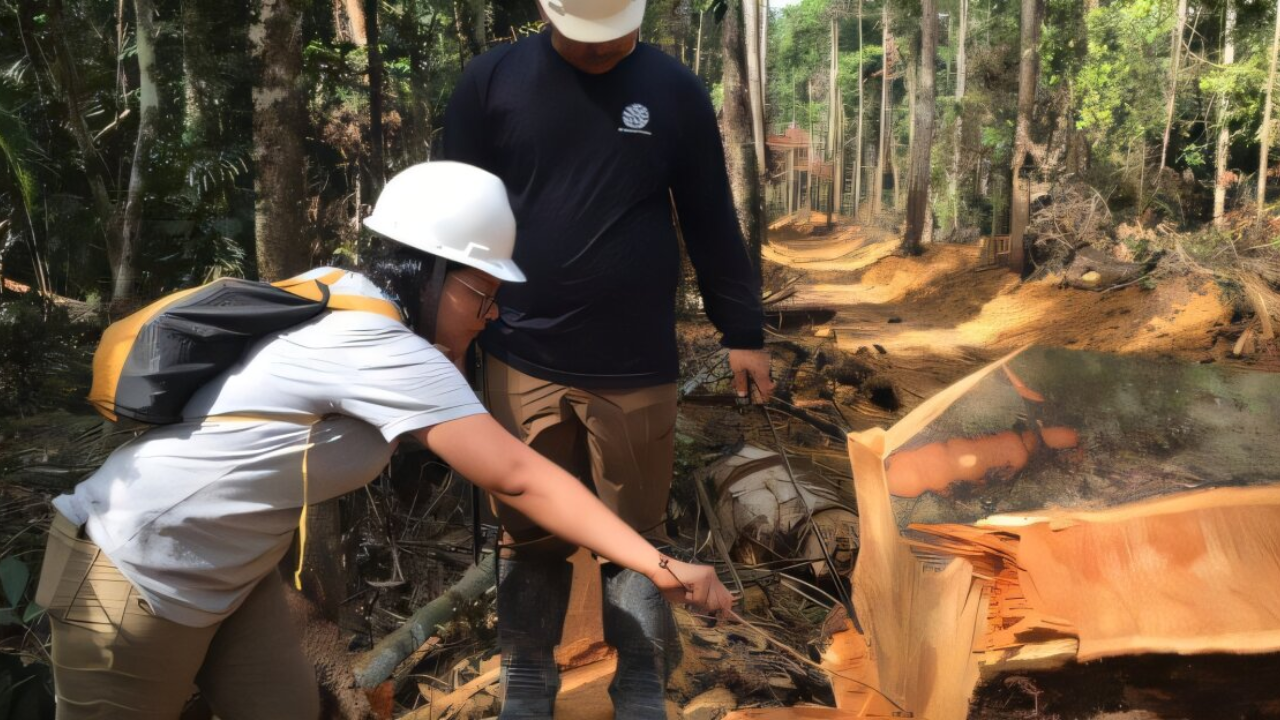
Paperwork is easy to fake in the timber trade. If you want to launder illegally harvested trees in the Amazon, you just forge a Forest Origin Document (DOF). For years, enforcement agencies struggled to catch loggers who claimed their timber came from authorized plots when it was actually ripped straight from protected indigenous reserves.
That paper trail is finally breaking down. Scientists at the University of São Paulo's Center for Nuclear Energy in Agriculture decided to let the trees speak for themselves.
The Science Behind Atomic Fingerprinting
Trees absorb water and nutrients from their local soil and environment. As they grow, they lock tiny chemical signatures right into their cellulose.
Researchers sampled 800 trees across 63 distinct locations in the Amazon to build a massive isotopic database. They track natural variants of elements like oxygen, carbon, nitrogen, and strontium. Because soil compositions and rainfall patterns shift across the vast basin, wood from one region has a totally different atomic weight than wood from another.
It acts just like a human fingerprint. Except it belongs to the earth.
Catching Forgers in Real Time
When environmental police or agencies like IBAMA seize a suspicious shipment of timber, they no longer have to rely purely on basic visual inspections or easily tampered administrative paperwork. They can extract a small core sample, run it through the isotopic model, and check the chemical profile against the map.
The model can immediately rule out up to 92 percent of the forest when tracing fraudulent shipments. It eliminates guesswork. If a logger claims a batch of high-value ipê came from a legal plantation in the south, but the strontium and oxygen ratios scream central Amazonian basin, the fraud is exposed instantly.
What This Means for Global Markets
Supply chain transparency has always been a nightmare in South America. Agribusiness investment funds and international buyers face massive commercial risks due to illegal deforestation. Nobody wants to buy furniture or building materials stained with the destruction of protected habitats.
By giving the Federal Police an auditable, hard-science tool, Brazil is changing the economics of logging. Crime stops being profitable when law enforcement can scientifically disprove your paperwork in a laboratory.
The database is still expanding. As researchers map more coordinates and fine-tune machine learning models to handle complex isotopic shifts, the net tightens further. Illegal loggers can still slice open remote roads through the jungle, but they can't rewrite chemistry.
Verify your suppliers, demand isotopic verification on high-risk tropical hardwoods, and stop trusting unverified paper permits.
Brazilian scientists finally reach the tallest tree in the Amazon
This video provides an immersive look into deep Amazon forestry expeditions and the remote environments where researchers gather critical biological data.
http://googleusercontent.com/youtube_content/1