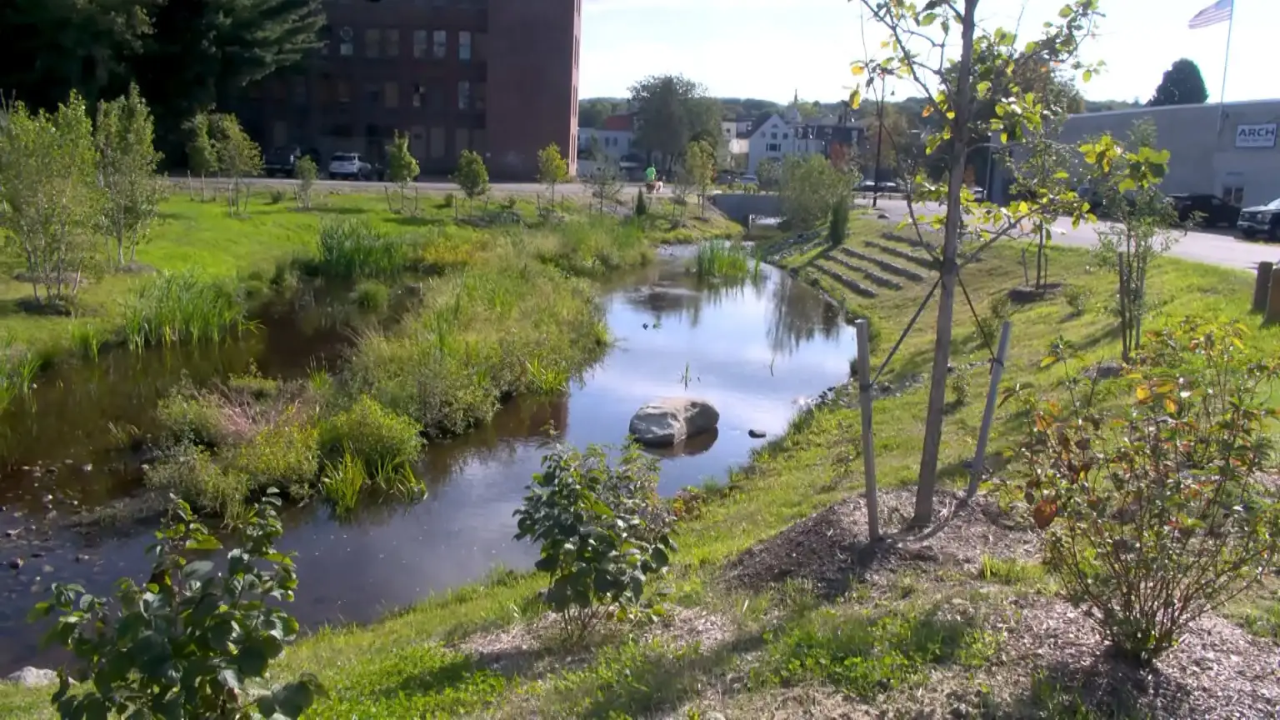
For half a century, a Massachusetts stream lived in the dark. Mill Brook was shoved into a concrete culvert and buried right beneath a dull downtown parking lot in Athol. Nobody thought twice about it. It was just an ugly urban patch where you parked your car to grab groceries or run errands.
Then the town decided to do something radical. They tore up 53,000 square feet of stubborn asphalt, let the trapped water see daylight, and turned a concrete desert into a functioning ecosystem.
If you think modern urban planning is all about pouring more concrete for cars, Athol just proved you dead wrong. This $3 million undertaking—now officially named Mill Brook Crossing—offers a masterclass in fixing old municipal mistakes. Let's look at how they pulled it off and why more cities should follow suit.
Tearing Up the Asphalt to Cool Downtown
Urban heat islands are a quiet crisis. Expansions of dark pavement absorb the sun's energy all day long and radiate it back out at night. Downtown Athol was dealing with precisely this issue at the old Lord Pond Plaza.
Instead of repaving or patching up the decaying lot, local leaders used climate resilience planning to rethink the space completely. They dug up 53,000 square feet of pavement. In its place, they planted over 80 new trees and reintroduced native greenery.
That expanded tree canopy and vegetation directly combat extreme heat. It changes the local microclimate. When you replace a massive solar heat sink with living plants, the ambient temperature drops. People walking downtown notice the difference immediately. It turns a place you want to rush through into a place where you might actually want to sit down and stay awhile.
Daylighting Mill Brook After Fifty Years
Burying urban streams was a popular engineering trick in the mid-20th century. Planners thought they were solving drainage problems or maximizing flat real estate for automobiles. In reality, they created massive ecological bottlenecks.
Athol reversed that short-sighted logic. The project successfully daylighted about 500 linear feet of Mill Brook. The stream no longer runs through a dark underground pipe. It flows right out in the open air, looping through the newly redesigned downtown layout.
Bringing a stream back to the surface isn't just about aesthetics. It reconnects fragmented habitats for local wildlife and pollinators. Water that runs through an open channel behaves differently than water forced through artificial conduits. It oxygenates, interacts with natural riverbeds, and slows down.
Managing Stormwater Before It Floods the Town
Pavement doesn't absorb water. When heavy rain hits a massive parking lot, it rushes straight into local storm drains, overwhelming municipal infrastructure and causing flash floods.
Mill Brook Crossing fixes that structural failure by letting nature do the heavy lifting. The new design incorporates bioswales, rain gardens, and porous pavement. These elements trap rainwater on-site, allowing it to filter slowly through the ground instead of pooling dangerously on hard surfaces.
Around 12,000 square feet of brand-new wetlands were created right in the middle of a commercial downtown. These wetlands act as natural sponges. They absorb excess runoff, filter pollutants out of the water before they reach broader waterways, and protect downstream areas from sudden surges.
Fixing Pedestrian Safety and Traffic Flow
The old Lord Pond Plaza wasn't just an ecological dead zone. It was also a chaotic mess for anyone trying to navigate it on foot. The layout prioritized cars over people, creating awkward traffic patterns and sketchy pedestrian pathways.
When the town redesigned the area, they fixed the human side of the equation. Backed by nearly $250,000 from Massachusetts' Complete Streets program, the project built proper sidewalks and organized the traffic flow.
You can have the best environmental restoration in the world, but if people don't feel safe walking through it, the project fails half its purpose. Athol made sure the space functions for daily human life, blending environmental engineering with practical urban mobility.
How It Started and What It Costs
Big infrastructure projects don't happen overnight. Athol started laying the groundwork way back in 2020 through municipal vulnerability planning. They secured state engineering grants, lined up construction funding, and watched the total cost climb to roughly $3 million.
In July 2026, the Athol Select Board officially renamed the site from Lord Pond Plaza to Mill Brook Crossing. A ribbon-cutting ceremony followed in September, marking the end of construction and the beginning of a new chapter for the town.
It is a steep price tag for a small central Massachusetts town. Yet, leaders viewed it as an investment in survival rather than a cosmetic upgrade. Dealing with chronic flooding and surging heat costs municipalities millions in emergency repairs anyway. Fixing the root cause just makes smart financial sense.
What Other Towns Can Learn From Athol
Most cities have a buried stream somewhere beneath a downtown parking lot or an industrial park. We spent decades hiding our natural waterways behind concrete walls because we thought we could outsmart nature.
Athol shows us the exact opposite. You cannot engineer your way out of climate stress with more asphalt.
If your town is sitting on outdated, heat-trapping pavement that constantly floods during heavy storms, take notes. Look at your local zoning laws, check for state or federal resilience grants, and start asking why your natural waterways are still hiding underground. Stop treating nature like an inconvenience to be paved over. Bring the water back to the surface.