The military has a massive logistics problem hiding in plain sight. It isn't the planes or the massive cargo ships crossing the Pacific. It is the yard work. Moving thousands of tons of armor, ammunition, and fuel from a main rail line onto the specific loading docks of a military base requires locomotives, specialized crews, and hours of coordination. If a single locomotive breaks down or the crew hits their maximum service hours, the whole chain stops.
The U.S. Army is testing a way to bypass the locomotive entirely.
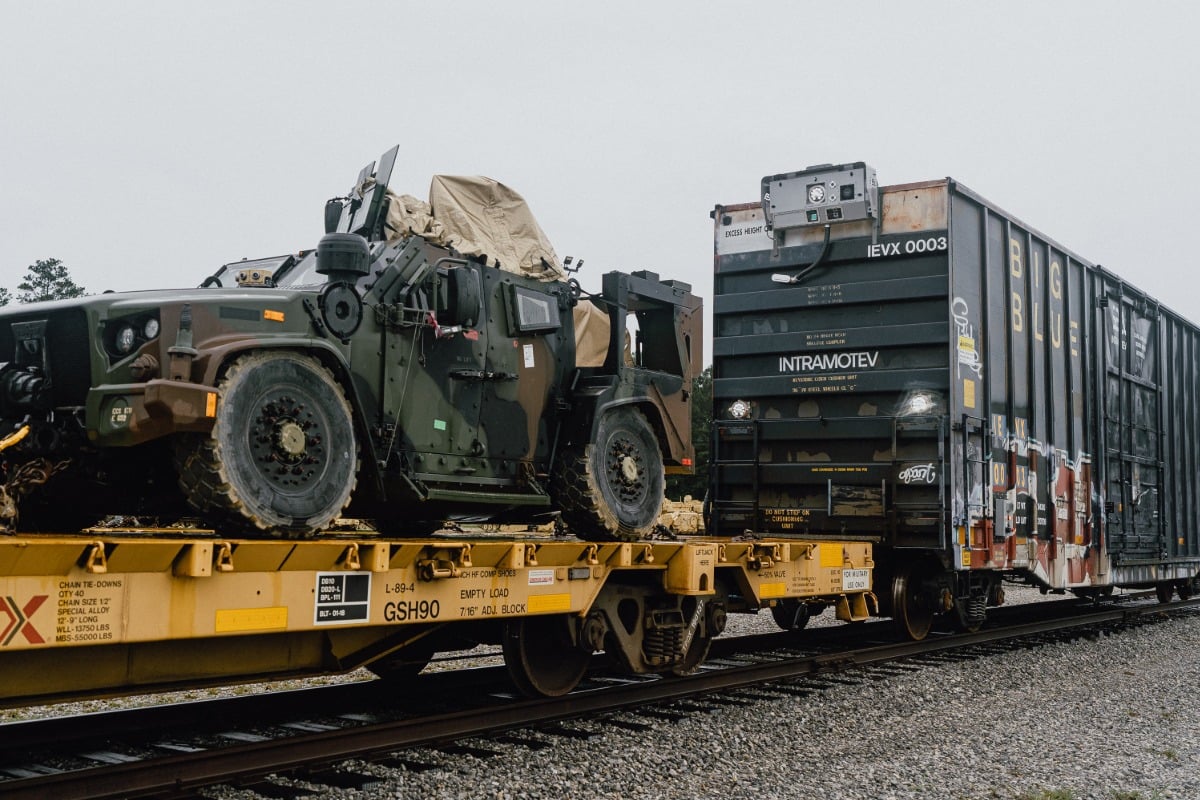
During Operation Sentinel Justice at Camp Shelby in Mississippi, the Army Reserve put an autonomous, battery-electric freight railcar called TugVolt through its paces. Built by St. Louis-based startup Intramotev, the system essentially turns an ordinary, dumb flatcar into a self-propelled robot capable of moving itself and other cars around a rail yard.
This isn't a minor science experiment. Sentinel Justice is the largest training event in U.S. Army Reserve history, drawing between 12,000 and 15,000 troops. Inserting a commercial robotic railcar into this chaos shows exactly where military logistics is heading.
Breaking the Locomotive Bottleneck
Traditionally, moving rail cargo inside an army post or a deployment hub requires a switcher locomotive. These are smaller, diesel-powered engines meant exclusively for shuffling cars back and forth between tracks. They are expensive, require constant maintenance, and demand a dedicated crew to operate.
The TugVolt system uses a retrofit kit. It packs heavy-duty electric motors and a battery pack directly onto the underside of standard railcars. Instead of waiting for a locomotive to arrive, a soldier uses a remote interface to command the individual railcar to uncouple, move down the track, and position itself exactly where it needs to be loaded.
During the Mississippi exercise, soldiers from the 757th Expeditionary Rail Center used the vehicle to move Department of Defense railcars between spurs without any locomotive assistance. When a real-world shipment of military cargo arrived via rail in the final hours of the exercise, crews used the autonomous car to spot and reorder the train cars on the fly.
The Reality of Power Projection
Logistics experts frequently talk about "power projection platforms"—the specific domestic bases tasked with rapidly moving massive amounts of heavy equipment to ports during a crisis. If the U.S. needs to deploy an armored brigade to Europe or Asia, everything moves by rail first.
The friction happens in the "gaps and seams" of these installations. A single broken switcher engine can delay a deployment by days. By putting self-propelled capability directly into the hands of the soldiers on the ground, the Army eliminates a single point of failure. If one railcar has an issue, the others can still move themselves.
The commercial world is already validating this data. Intramotev has had these systems running in revenue service for Carmeuse Americas in Michigan's Upper Peninsula, where they moved over 350,000 tons of material in 2025 alone. On that specific commercial line, the technology eliminated the need for a second diesel locomotive entirely.
Why Electric Rail Makes Tactical Sense
Switching to battery-electric railcars inside an army base provides a few distinct advantages over traditional diesel engines:
- Zero Idle Emissions: Diesel locomotives spend hours idling in yards, wasting fuel and creating thermal signatures. Electric railcars only draw power when moving.
- Instant Torque: Electric motors provide maximum torque instantly, making them incredibly efficient at starting heavy, static loads from a dead stop.
- Simplified Maintenance: An electric drivetrain has a fraction of the moving parts of a diesel-electric locomotive, reducing the mechanical footprint needed on a base.
The test at Camp Shelby involved a massive network of commands, including the 75th Innovation Command, the 377th Theater Sustainment Command, and the Mississippi Army National Guard. The consensus from the ground was that soldiers became proficient with the remote operation systems almost immediately.
What Happens Next
The immediate goal for the Army is to evaluate how these autonomous switchers handle sustained, heavy abuse in austere environments. While the tech works well on private commercial tracks in Michigan, military deployment hubs present unpredictable loads and rapid operational tempos.
Expect to see further testing focus on scaling these systems so a single operator can manage a small fleet of independent cars simultaneously, turning a disorganized rail yard into a fully automated, self-sorting warehouse.
Check out the autonomous railcar in action
This video shows how engineering teams simulate and model the control systems of these exact 600-mile-range autonomous railcars before deploying them to the field.