Museum basements are full of secrets. You think everything on a shelf has been cataloged, studied, and perfectly labeled. It hasn't. Museums and research stations around the world hold thousands of rocks and bones waiting for someone with the right expertise to take a second look.
That's exactly how the first dinosaur bone ever collected from Antarctica sat invisible for four decades.
In December 1985, a geologist named Mike Thomson was mapping rock layers on James Ross Island. It's a brutal, wind-scoured spot off the coast of the Antarctic Peninsula. He spotted a lumpy, grey chunk of stone about 10 centimeters wide. He sketched it neatly in his field notebook on December 9, labeling it a "vertebra of large reptile."
He assumed it belonged to an ancient marine reptile. Most fossils found in those marine rock layers did. He packed it up, sent it back to the British Antarctic Survey headquarters in Cambridge, and it went straight into a storage drawer.
It stayed there until paleontologist Mark Evans cleared off the dust.
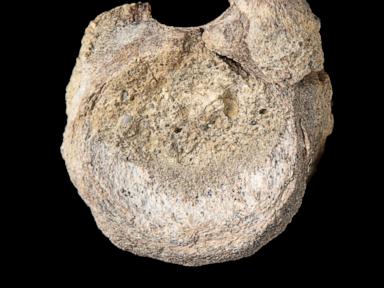
What looked like an ordinary rock turned out to be the tail bone of a titanosaur. These were long-necked, plant-eating giants. They were some of the largest creatures to ever walk the earth. The discovery, published in June 2026 in the journal Acta Palaeontologica Polonica, changes what we know about prehistoric life at the bottom of the world.
The Bone ID Mistake Anyone Could Make
It's easy to judge the original expedition team for missing the find. Don't.
Antarctic fieldwork is brutal. You are freezing. Your fingers are numb. You are racing against incoming storms and limited helicopter fuel. Thomson wasn't looking for dinosaurs. He was mapping stratigraphy and collecting marine fossils to date the rock layers.
When you find a vertebrate bone in a marine deposit, your brain defaults to what makes sense. You expect a plesiosaur or a mosasaur. Those massive marine reptiles swam the Cretaceous seas. A land-dwelling dinosaur is the last thing on your radar.
Thomson passed away in 2020. He never knew he had held a piece of a giant land animal.
Mark Evans, working through the British Antarctic Survey collections, noticed the unique structure of the specimen. It didn't look right for a marine reptile. He reached out to Paul Barrett from the Natural History Museum in London. Together, they examined the anatomy of the 82-million-year-old bone.
The giveaway was the joint style. The bone had a distinct cup-like hollow on one end and a rounded, ball-like bump on the other. This created a ball-and-socket system. It's a specific anatomical feature found in the tail vertebrae of titanosaurs. It gave their massive tails flexibility and strength.
This single bone proved that titanosaurs roamed Antarctica during the Late Cretaceous.
The Real Cretaceous Antarctica Was Unexpectedly Green
Forget the endless white ice sheets.
Eighty-two million years ago, the South Pole didn't look like an apocalyptic ice desert. The planet was experiencing an intense greenhouse phase. Carbon dioxide levels were high. Temperatures were warm.
The region was covered in dense, temperate forests. Think of modern New Zealand or the Pacific Northwest, but pushed to the bottom of the globe. Conifers, ferns, and flowering plants carpeted the landscape.
It wasn't a tropical paradise. The high latitude meant the region experienced months of total darkness during the winter. Animals living there had to survive prolonged periods without sunlight. Temperatures dropped, but it didn't freeze over completely.
This environment provided plenty of food. A plant-eating dinosaur could actually survive here.
The specimen found in the drawer was relatively small. Scientists estimate the creature was about 23 feet long. That's tiny for a titanosaur. Some species in this group reached lengths of over 115 feet and weighed 60 tons.
Was this a juvenile? Or was it a dwarf species adapted to the island environment? We don't have enough pieces of the puzzle yet.
The dinosaur likely died near a river or a coastline. Its carcass washed out to sea. It bloated, floated, and eventually sank to the ocean floor. Marine sediment covered the bones. Millions of years of geological pressure turned the seabed into the rock layers of James Ross Island. That explains why a land animal ended up surrounded by ancient sea life.
Why Finding Fossils in Antarctica is an Absolute Nightmare
Paleontologists love to joke about the hardships of the field, but Antarctica is a different beast entirely.
Less than one percent of the continent is free of ice. Most of the rock is buried under miles of solid glaciers. The few places where rock layers are exposed, like the Antarctic Peninsula and the Transantarctic Mountains, are incredibly difficult to reach.
You need heavy logistics. You need ships, helicopters, and unpredictable weather windows. A sudden blizzard can trap a research team in their tents for a week, ruining an entire field season.
When you actually get to the rock, you face extreme freeze-thaw cycles. This process shatters exposed fossils into thousands of tiny crumbs before anyone can find them.
The fact that any dinosaur bones survive is a minor miracle.
Because of these barriers, our understanding of southern high-latitude ecosystems has massive gaps. Every single bone matters. This single tail vertebra fills a critical space in the puzzle. It shows that titanosaurs weren't just restricted to South America, Africa, and Australia. They migrated across land bridges all the way to the southern tip of the globe.
Museum Drawers are the New Frontier for Discovery
This discovery highlights a massive issue in modern science. We are obsessed with funding new expeditions, but we neglect the collections we already have.
Thousands of boxes sit in museum basements worldwide. They contain specimens collected decades ago that have never been thoroughly analyzed. Funding for collections management is low. Experts who can properly identify obscure bones are rare.
We don't just need more field trips. We need more scientists looking inside the drawers we already filled.
New technology makes these old collections even more valuable. In 1985, Mike Thomson couldn't run a high-resolution CT scan on his fossil. Today, researchers use advanced imaging to peer inside petrified bone structures without damaging them. They can analyze growth rings, look at vascular networks, and determine the age of the animal when it died.
An old rock sitting in a drawer for 40 years can suddenly reveal new data because our tools caught up to the science.
What to Do If You Want to Study Ancient Fossils
If this discovery excites you, don't just sit there. You can get involved in paleontology and collections research without needing a massive expedition budget right away.
Volunteer at Local Museums
Most regional museums are drowning in uncataloged geological specimens. They need volunteers to clean, label, and organize storage boxes. You get hands-on experience handling real specimens and learning how collections operate.
Learn Anatomy and Osteology
The key to Mark Evans' discovery was recognizing a ball-and-socket joint on a dirty rock. Train your eyes. Study comparative anatomy. Understand how bones differ between reptiles, mammals, and birds.
Learn Digital Mapping and GIS Tools
Modern paleontology relies heavily on data. Geologists use geographic information systems to track where fossils were found and match them to specific rock layers. Mastering these digital tools makes you incredibly valuable to research teams.
Look Closely at the Ordinary
The biggest discoveries often look like boring grey rocks at first glance. Train yourself to observe the details. Look for symmetry, unique textures, and subtle patterns that differentiate a fossilized bone from common stone.
The next major scientific breakthrough might not be buried under the Antarctic ice sheet. It might be sitting in a cardboard box on a shelf three miles from your house. Open the drawer. Keep your eyes open.