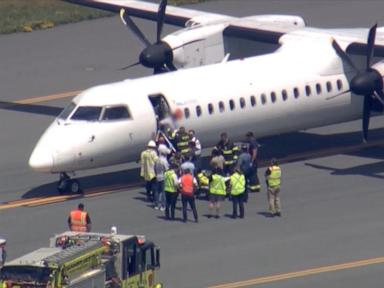
You are sitting at ten thousand feet, watching the clouds pass by, when the airplane suddenly jerks. It is not the typical shudder of a pocket of rough air. The plane swerves violently, tilting hard to one side as if someone yanked the controls. Inside the cabin, panic sets in immediately. Passengers start praying.
This exact nightmare became a reality for sixty-one passengers aboard an Air Canada regional flight operated by PAL Airlines. The flight departed Newark, New Jersey, bound for Halifax, Canada. Shortly after takeoff, the captain suffered a severe medical emergency, experiencing a sudden seizure right at the controls. When a pilot becomes incapacitated midair, the line between a routine flight and absolute catastrophe shrinks in seconds.
The aviation industry spends billions ensuring two pilots are always in the cockpit. We often treat the first officer as an apprentice or a backup, but they are fully qualified captains in waiting. When the worst happens, they are the only thing standing between a safe landing and tragedy. The Newark to Halifax flight proved the system works, but it also exposed the raw, terrifying reality of a midair crisis.
Inside the Flight Deck Nightmare
When the captain of the de Havilland Dash 8-400 suffered a seizure, the aircraft did not just keep flying straight on autopilot. The physical nature of a medical emergency means a collapsing body can easily slump forward, pushing against the yoke or kicking the rudder pedals. That is exactly why passengers felt the plane swerve violently over and over. It felt like someone was fighting the plane.
In these terrifying minutes, the flight attendant had to step into a chaotic situation. Protocol dictates that the remaining pilot must focus entirely on flying the airplane. They cannot leave their seat to drag a heavy, unconscious colleague off the controls. The flight crew rushed to pull the captain out of the flight deck.
A passenger named Rodney McDonald, who was traveling with his wife and sons, realized something was fundamentally wrong. He moved away from his family to help the crew. It took a grueling, strenuous forty minutes of physical effort to keep the incapacitated pilot down. The crew and passengers used multiple seatbelts to tie down the captain's legs, arms, and chest so he would not inadvertently interfere with the flight systems again.
While this physical battle happened right outside the cockpit door, the first officer was completely alone at the controls. They had to stabilize the twitching aircraft, talk to air traffic control, and find a safe place to land. They diverted to Boston Logan International Airport. Air traffic controllers cleared the airspace, shutting down Runway 27 for all other traffic to give the solo pilot a clear path home. The plane landed safely, emergency vehicles surrounded the tarmac, and everyone walked away alive.
The Illusion of the Automated Cockpit
A common myth among the traveling public is that modern airplanes basically fly themselves. People think a co-pilot just pushes a button, lets the autopilot do the heavy lifting, and sips coffee. That is a dangerous misunderstanding of how aviation works.
Autopilot is a fantastic tool for reducing fatigue during long, boring cruise phases. It is completely useless if a collapsing human body is physically overriding the controls. The first officer on that PAL Airlines flight had to instantly recognize that the erratic flight path was not a mechanical failure, but a human one. They had to apply counter-pressure to the yoke, disconnect the automated systems if necessary, and manually fly a heavy twin-turboprop aircraft while their partner was incapacitated beside them.
Single-pilot operations in a complex commercial environment double the mental workload instantly. The remaining pilot must handle the radio, read the emergency checklists, monitor the fuel, track the weather, and configure the aircraft for landing entirely by themselves. There is no one to double-check their math. There is no one to verify that they flipped the correct switch.
How Airlines Train for the Worst Case Scenario
Aviation safety is built on a foundation of absolute paranoia. Every single commercial airline pilot undergoes rigorous simulator training every six months. They do not just practice engine failures or bad weather landings. They practice pilot incapacitation.
The training teaches first officers a specific sequence of actions when their partner slumps over.
First, they assume manual control of the aircraft and establish a safe altitude.
Second, they secure the incapacitated pilot. This is crucial because a limp body can slump forward onto the yoke, nose-diving the plane. Pilots are trained to slide the incapacitated person's seat all the way back, lock the harness, and tilt the backrest away from the instrument panel.
Third, they declare an emergency. On the radio, the phrase is simple and direct. The PAL Airlines first officer radioed air traffic control to state clearly that the pilot was incapacitated and the aircraft was being flown single-pilot. This instantly triggers a massive emergency response on the ground, clearing the skies for miles around.
The Growing Debate Over Single Pilot Commercial Flights
This real-world emergency highlights a massive battle happening behind the scenes in the aviation industry. Global airlines are actively pushing aviation regulators to allow single-pilot operations for parts of commercial flights to cut costs and handle pilot shortages. They want to remove the second pilot from the cockpit during the long cruise phase of flight, leaving just one person at the controls while the other rests.
Aviation unions and safety advocates are fighting this proposal with everything they have. The Air Canada regional incident shows exactly why having two fully qualified pilots in the cockpit is non-negotiable. If that seizure had happened on a experimental single-pilot flight while the lone pilot was at the controls, there would be no first officer to save the day. The aircraft would simply be out of control.
Defenders of single-pilot technology argue that ground-based pilots could remotely take over an aircraft via data links if a medical emergency occurs. Airplanes are vulnerable to cyber interference, data drops, and satellite lag. A remote pilot thousands of miles away cannot physically pull a seizing captain off the control yoke. They cannot look out the window to verify visual cues. The physical presence of a second human being in that cockpit was the sole reason sixty-one passengers made it to Boston alive.
What You Should Do in an Aviation Emergency
If you ever find yourself on a flight where a medical emergency turns into a cockpit crisis, your role as a passenger changes instantly. You need to know how to react without making a bad situation worse.
- Stay in your seat unless explicitly asked to help. The flight attendants are trained professionals. A crowded aisle blocks them from getting emergency medical equipment or accessing the flight deck.
- Follow instructions without question. If a crew member asks for strong passengers to help move or restrain someone, step up immediately. If they tell you to sit down, do it.
- Do not film the crisis. It sounds obvious, but recording a medical emergency for social media blocks the aisle and delays vital care. Focus on the safety of the cabin instead.
The flight from Newark eventually made it to its destination in Halifax later that night, after a long delay in Boston. The passengers were shaken, but they were safe. The system worked exactly the way it was designed to work. The next time you board a commercial flight and see two pilots walking down the jetway, remember that the second person in that cockpit is not an assistant. They are your ultimate insurance policy.