For forty years, paleontologists argued over a handful of broken teeth found in the dirt. Those tiny molars looked suspiciously like the grinding teeth of modern plant-eating mammals, leading experts to assume they belonged to early ancestors of hoofed placental species. They were wrong. A remarkably preserved skeleton unearthed in Mongolia's Gobi Desert has just blown that theory apart.
The new fossil, named Tamirkhan balcarceli, forces science to redraw the family tree of Cretaceous mammals. It proves that nature played a massive trick on us through convergent evolution, making completely unrelated animals look identical on the dinner plate end of things.
The Mystery of the Zhelestids
If you dig up a pile of isolated teeth, you are basically trying to guess an entire animal from its kitchen utensils. That is the trap researchers fell into with zhelestids. For nearly four decades, this extinct group baffled everyone because nobody had ever found a complete skull and skeleton belonging to the same individual.
The teeth were broad, rounded, and looked built for grinding vegetation. Because modern placental mammals use similar teeth for a similar diet, scientists slotted zhelestids close to the root of the placental lineage. It felt logical. It fit the models.
Then Andres Giallombardo found a complete specimen during a 2004 expedition sponsored by the American Museum of Natural History. Described recently in the journal Nature, the resulting study changes everything. When you look at the skull, the lower incisors, and the elongated hind legs all attached to the same backbone, the animal stops looking like a proto-ungulate and starts looking like something else entirely.
Anatomy of a Cretaceous Runner
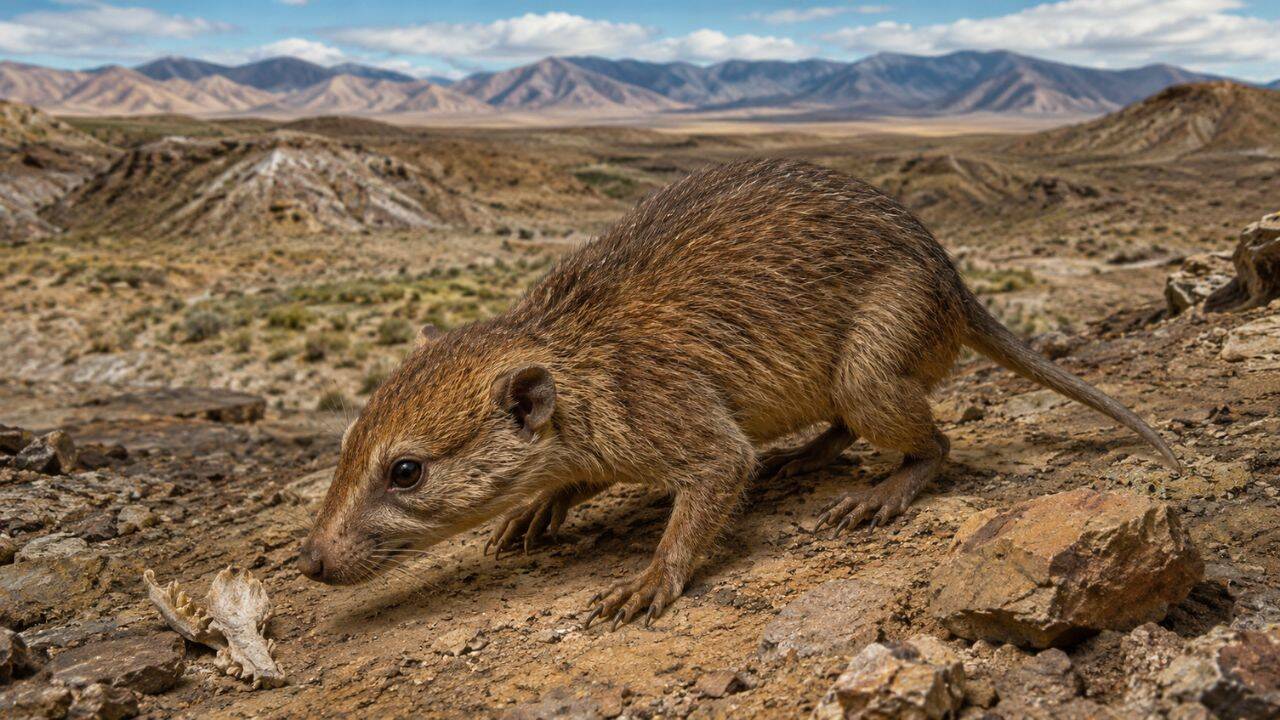
Measuring roughly six to seven inches long, Tamirkhan balcarceli looked kinda like a tiny, prehistoric rabbit. It wasn't actually related to rabbits, but its proportions tell a clear story of survival.
Its hind limbs were long and slender, featuring fused lower leg bones and specialized ankles built for speed. In a Late Cretaceous world dominated by hungry dinosaurs, being able to bolt across the landscape mattered.
The skull held even bigger surprises. It featured translacrimal canals—specialized facial openings—and jaw traits that tied it directly to Zalambdalestoidea, an entirely different extinct branch of small, shrew-like Gobi mammals.
Zhelestids weren't early placental pioneers after all. They were specialized zalambdalestoids that happened to evolve grinding molars on their own.
Why Convergent Evolution Fools the Experts
Nature loves repeating a good design. When two different animal lineages face the same ecological pressures, they often stumble on identical physical solutions.
That is textbook convergent evolution. Just as dolphins and sharks share a streamlined shape despite coming from different biological classes, these Cretaceous mammals developed similar teeth because their local environment demanded a shift toward more varied, abrasive foods.
Molecular clock studies often suggest that true placental mammals originated way back in the Cretaceous, hiding in the shadows of the dinosaurs. This discovery throws cold water on those models. It shows that dental traits alone cannot reliably anchor a species to the placental family tree.
Fieldwork Still Beats Computer Models
It is easy to sit in a modern lab and run genetic or anatomical algorithms on fragmented data. Algorithms give clean, comfortable answers. But bones in the desert don't care about clean models.
This find highlights why physical field paleontology remains irreplaceable. Without a pristine fossil containing teeth, skull, and limbs from the exact same creature, science would still be guessing. The Gobi Desert keeps proving it is one of the ultimate treasure troves for Mesozoic mammal evolution, regularly turning decades of consensus upside down with a single block of sandstone.
Stop treating historical taxonomy as a settled book. Every expedition in places like Mongolia writes new margins into the text.