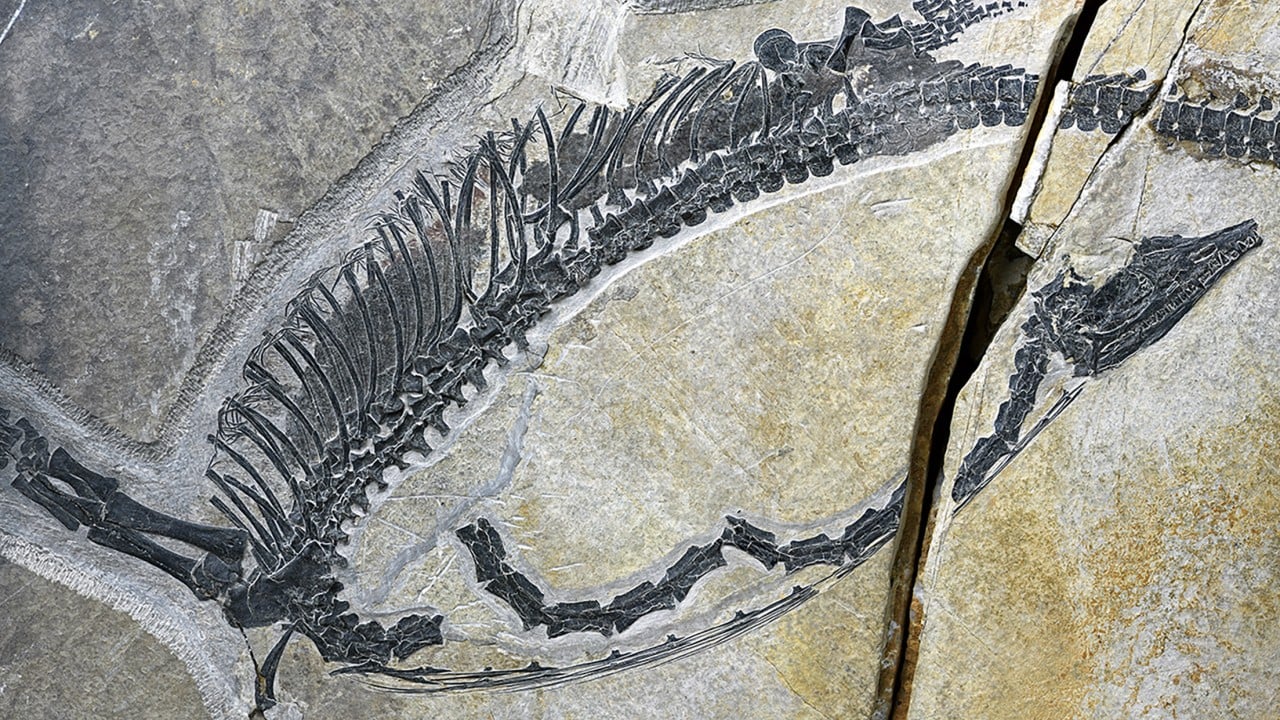
Soft tissues usually rot away long before fossilization can work its magic. Bones survive, but guts vanish. That rule just got broken in spectacular fashion. Paleontologists working in southwestern China's Yunnan Province pulled a 245-million-year-old marine reptile out of the rock, and its last meal, stomach, and liver are still sitting right where they left off during the Triassic period.
The animal, named Austronaga minuta, measures about 60 centimeters long and looks a bit like a miniature, long-necked phantom of the ancient Tethys Sea. More importantly, it provides the oldest known complete digestive tract ever found in a reptile.
Inside the Belly of the Beast
When an international research team analyzed the fossil using modern imaging and analytical methods like UV light photography and mass spectrometry, they didn't just find a skeleton. They found an intact internal roadmap.
Right behind the ribcage sits a large, sac-like stomach containing tiny fish scales. That fish lunch gives researchers direct proof of the animal's predatory habits. But the real shocker sits right behind the stomach. The liver is not only preserved, but it still maintains a dull reddish hue due to lingering traces of hemoglobin.
Trailing behind the liver is a straightforward, uncomplicated tube functioning as the small and large intestines.
Why Simple Guts Rewrite Evolutionary Trees
Austronaga belongs to the broader lineage of archosaurs—the powerhouse group that eventually branched into modern crocodiles, dinosaurs, and birds. Today's archosaur descendants, like crocodilians and birds, feature complex, two-part stomachs.
This fossil proves that early marine archosaurs didn't start with that complexity. Their plumbing was basic.
Dr. Nick Fraser from National Museums Scotland points out that while the animal's external body was heavily modified for aquatic survival—complete with paddle-like limbs and a powerful swimming tail—its internal organs lagged behind in evolutionary simplicity. Evolution built the swimming body first, while the complex digestive upgrades came much later.
What China's Fossil Beds Keep Uncovering
The Guanling and Luoping formations in southern China continue to yield preservation miracles. Because these ancient equatorial environments experienced specific chemical conditions right after Earth's worst mass extinction event, creatures that sank to the sea floor were shielded from scavengers and rapid decay.
Finds like Austronaga remind us that bone shapes only tell half the story. Sometimes, you have to look inside the ribcage to truly understand how prehistoric life conquered the oceans.
Check local university paleontology departments or open-access journals like Science Advances to track ongoing imaging updates on these soft-tissue Chinese fossils.