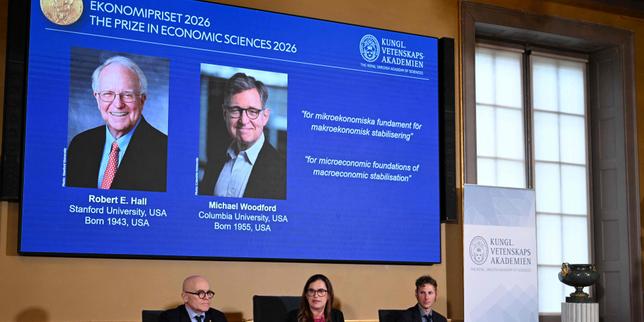
When central banks adjust interest rates or governments scramble to fund stimulus packages during a downturn, they aren't just guessing. They rely heavily on sophisticated theoretical frameworks that connect individual decisions to national economic performance. That core modeling work is precisely why American economists Robert Hall and Michael Woodford won the 2026 Nobel Prize in Economic Sciences.
The Royal Swedish Academy of Sciences honored Hall, based at Stanford University, and Woodford, based at Columbia University, for their groundbreaking contributions to the microeconomic foundations of macroeconomic stabilization. For decades, economic policy models relied heavily on loose statistical correlations between massive aggregates like inflation, output, and consumption. Hall and Woodford completely re-engineered those systems. They showed how actual decisions made by ordinary households and businesses drive the broader outcomes we experience during recessions and periods of high inflation.
Rebuilding the Engine Room of Macroeconomics
Old economic models looked a lot like weather forecasting without physics. Economists would track historical data points—like past interest rates versus past inflation rates—and draw straight lines. If rates went down, inflation usually went up. But that approach fell apart during major economic crises because it failed to explain why people changed their behavior.
Hall and Woodford changed that by grounding macroeconomics in rigorous microeconomic principles. They asked a fundamental question. What happens when a central bank alters borrowing costs?
The answer doesn't just depend on the central bank decree. It depends on expectations. A family decides whether to buy a house or pad their savings account. A business weighs whether to invest in new factory equipment or raise prices on retail shelves. By modeling these granular choices, Hall and Woodford created frameworks that allow central banks and finance ministries to design policies capable of smoothing out severe economic cycles.
The Power of Expectations
You can't talk about Michael Woodford's monumental impact without looking at how expectations shape reality. His seminal work, particularly reflected in his influential writings on monetary policy, transformed central banking.
Before Woodford, monetary policy was often viewed through a purely mechanical lens—controlling the money supply directly. Woodford demonstrated that modern central banking is largely about managing expectations about the future. When a central bank signals its path for future interest rates, consumers and corporations adjust their spending and pricing habits today. If people expect future inflation to remain anchored, price spirals become much less likely. Central bankers across the globe now treat communication and credibility as primary monetary tools, largely because of this theoretical shift.
Meanwhile, Robert Hall focused heavily on consumption decisions and labor markets. He unpacked how households react to uncertainty, shedding light on why unemployment persists during downturns and how consumer caution amplifies recessions. His empirical and theoretical work gave economists better tools to measure the true costs of recessions and evaluate policies designed to combat joblessness.
Why This Matters Today
Economic theory sounds abstract until you experience a global shock. From the 2008 financial crisis to the post-pandemic inflation spikes, policymakers needed reliable tools to prevent total economic meltdown. The stabilization models built on the foundations laid by Hall and Woodford are the exact engines central banks use to calibrate interest rates and avoid tipping millions into unemployment.
By connecting micro-level consumer behavior to macro-level stabilization policies, these two laureates bridged a massive gap in economic science. They proved that you cannot steer an economy by staring only at the dashboard gauges. You have to understand the drivers behind the wheel.
Take a look at how central banks communicate today compared to forty years ago. Forward guidance, transparency, and explicit target rates didn't happen by accident. They are the direct result of researchers like Hall and Woodford dragging economic models into the reality of human expectations and choices.
Understanding these foundations helps cut through the noise of daily financial headlines. When you hear about upcoming interest rate decisions or inflation forecasts, remember that the underlying math is built on the choices you and every other consumer make every single day.



.jpg/255px-Yvonne_strahovski_(cropped).jpg)