You rarely get a clean crime scene in paleontology. Usually, millions of years of shifting tectonic plates, sub-surface currents, and decay turn prehistoric skeletons into a jumbled puzzle. But every once in a while, nature leaves behind a pristine snapshot.
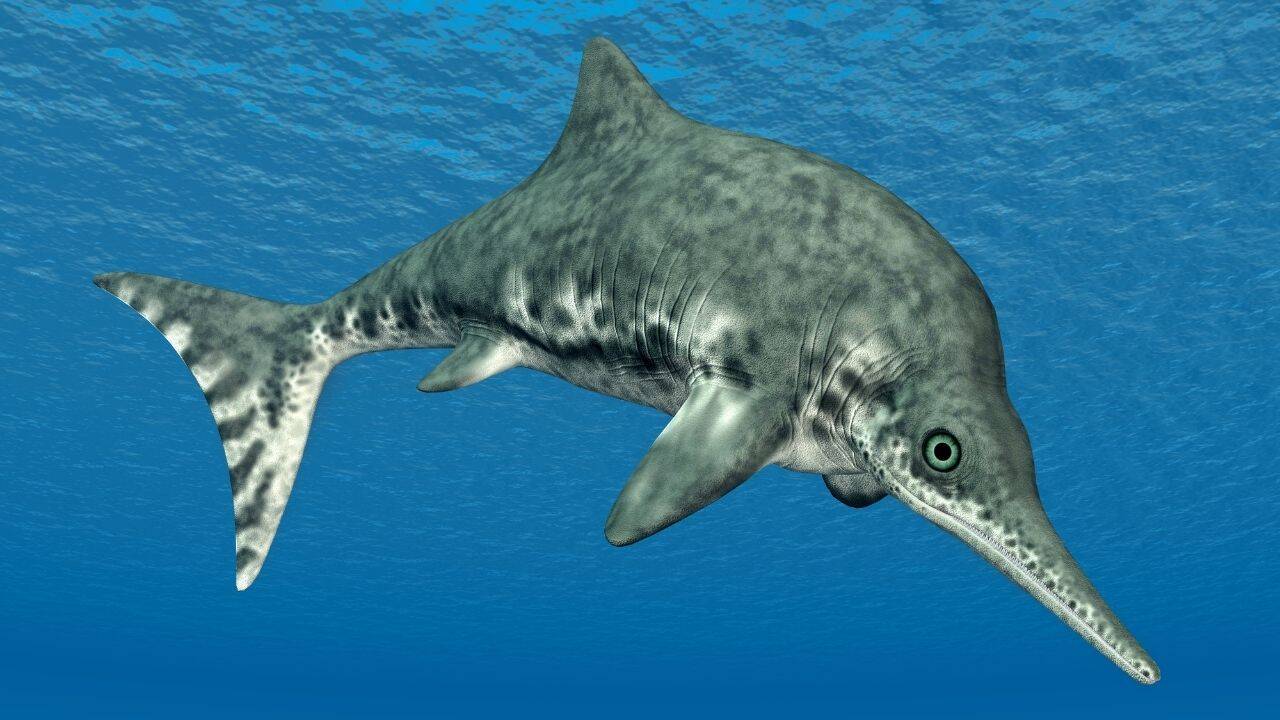
A 100-million-year-old ichthyosaur fossil discovered in the outback of Queensland, Australia, provides just that. Nicknamed "B.O.B." (short for Bag of Bones), this dolphin-shaped marine reptile didn't just preserve a skeleton. It locked a three-tier food chain directly into stone.
Peering Inside Without Breaking Anything
When recreational fossil hunters stumbled upon the bones near Richmond in 2019, they handed them over to the Kronosaurus Korner museum. Museum staff spent over 600 hours prepping the specimen, noticing peculiar rock nodules clustered right behind the skull.
Breaking open those nodules mechanically could have destroyed fragile, microscopic evidence. Instead, researchers turned to advanced technology. Using neutron tomography and high-resolution synchrotron X-ray scans—supported by the Australian Nuclear Science and Technology Organisation—scientists peeked inside the stone matrix without causing a single crack.
The scans revealed an extraordinary last meal.
Inside the ichthyosaur's stomach were the remains of fish, cephalopods (ancient relatives of squid and cuttlefish), and fragments of a pterosaur jaw. This marks the first direct fossil evidence ever found of an ichthyosaur dining on a flying reptile.
How an Ichthyosaur Caught a Flying Reptile
Picture the scene. Roughly 100 million years ago, a vast inland waterway known as the Eromanga Sea covered a massive chunk of Australia. It was a rich, terrifying soup of marine life.
The ichthyosaur, Platypterygius australis, measured roughly six to seven meters long. It was built for speed and pursuit. But flying reptiles don't typically swim into the mouths of marine predators.
Paleontologists believe the ichthyosaur didn't snatch the pterosaur out of mid-air. Pterosaurs frequently skimmed the ocean surface or floated while hunting for fish. That vulnerability spelled doom. The massive marine reptile likely ambushed the flying creature from below, dragging it down into the dark.
When the Hunter Becomes the Snack
Yet, eating a diverse meal of fish, squid, and a flying reptile didn't save this predator from its own grim fate.
The ichthyosaur's skeleton tells a brutal second story. Its vertebrae and ribs are heavily fractured, bearing massive, conical bite marks that go far beyond normal post-mortem decay. Bones are crushed and split apart, pointing to an attack by a truly colossal apex predator.
The culprit? Kronosaurus queenslandicus.
Often dubbed the T. rex of the ocean, this massive pliosaur reached lengths of roughly ten meters and possessed a skull built to generate terrifying bite forces. It bit down on the ichthyosaur with enough force to shatter bone, either killing it outright or scavenging the carcass shortly after its final meal.
Why This Discovery Changes How We View Ancient Ecosystems
Finds like B.O.B. matter because they dismantle rigid textbook assumptions about ancient food webs. We tend to view prehistoric predators in neat, isolated boxes. Fish eat smaller fish, big reptiles eat medium reptiles.
This fossil proves reality was far messier. It shows an ecosystem where boundaries blurred constantly. A pterosaur hunts for fish, gets intercepted by a swimming ichthyosaur, and that same ichthyosaur ends up chewed up by a giant pliosaur.
Non-destructive imaging tech like neutron scans is opening up fossils that museum drawers have hidden for decades. We are no longer limited to what we can see on the outside of a rock.
The next big paleontological breakthrough isn't necessarily about digging up a brand-new species in a remote desert. It is about taking a second look at old bones using modern physics, and letting the stone give up secrets it has kept for millions of years.